Helping a teenager with depression starts with connection, not correction. Most teens never announce they are depressed. Parents see irritability, slipping grades, and withdrawal long before anyone says the word depression, and the instinct to question, fix, or discipline usually pushes teens further away.
What works is the opposite: steady connection, validation before problem-solving, and knowing the signals that mean it is time for professional support.
In this article, our primary therapist Jessa Grossman explains how to tell depression apart from normal adolescence, how to reach a teen who insists nothing is wrong, and the well-intentioned mistakes we see parents make every week at Adolescent Wellness Academy.
Is It Depression or Normal Teenage Moodiness?
Some moodiness is part of adolescence. What separates a phase from something clinical comes down to three filters our therapists apply every day: intensity, duration, and impact on daily functioning.
| Normal adolescence | Possible depression | |
| Mood | Up and down, irritable some days, fine on others | Low or irritable nearly every day |
| Duration | Passes within days | Lasts more than two weeks |
| Activities | Drops one hobby, picks up another | Stops enjoying most things, replaces them with nothing |
| School | Occasional rough patch | Grades sliding steadily, missed assignments, absences |
| Sleep and appetite | Typical teenage patterns | Major, persistent changes in either direction |
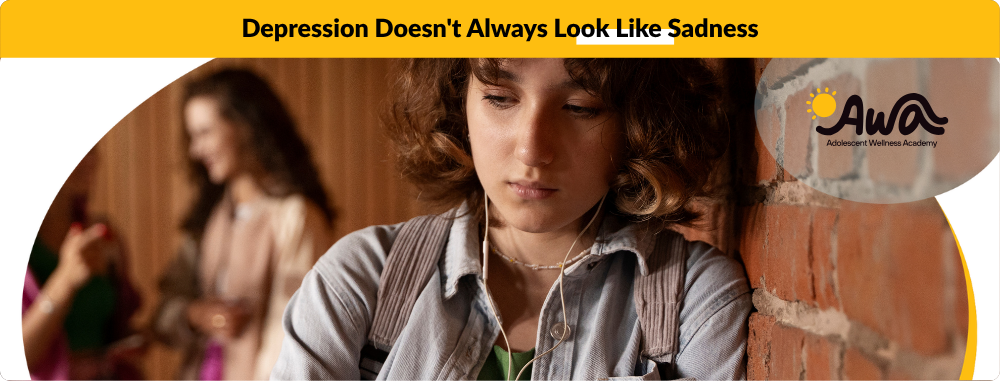
One thing catches many parents off guard: teen depression often does not look sad.
The National Institute of Mental Health notes that depression in teens frequently shows up as frustration, irritability, and anger rather than visible sadness.
A large part of what we see at intake is exactly that: parents describing an attitude problem or laziness that turns out to be a depressed teenager who never once looked sad at home.
School follows the same quiet pattern. A straight-A student brings home a few Bs, and it gets dismissed as a rough patch. Without support, that slide can accelerate until they are failing classes. A steady drop in school performance is one of the earliest measurable signs that something deeper is going on.
“Anything that shows a change in who the child once was. That’s what we ask parents to pay attention to.” Jessa Grossman, Primary Therapist, AWA
What You Can Do Right Now
If you recognize your teen in the column on the right, here is where to start:
- Open the conversation without pressure. Connection first. Interrogation shuts teens down.
- Validate before you fix. Your teen needs to feel understood before they will accept help.
- Keep home structure steady. Predictable routines and consistent follow-through. Not walking on eggshells, and not a lockdown.
- Loop in the school counselor. They see your teen six hours a day and can flag changes you cannot.
- Take safety signals seriously. Any talk of self-harm or not wanting to be alive means an evaluation now, not next month.
- Look into structured support built for teens. If symptoms have lasted weeks and daily life is affected, occasional therapy sessions may not be enough.
The rest of this article walks through the ones parents find hardest.
How to Reach a Teen Who Says Nothing Is Wrong
Most parents lead with questions. It feels natural. It is also the fastest way to get a bedroom door closed in your face.
The way in is usually not through the topic of depression at all. It is through a board game, a drive, an errand run together. You are not lowering your guard because you stopped worrying. You are building the safety that makes a real conversation possible.
One of our therapists puts it in three words: connect before correct. You cannot challenge the slipping grades or the slammed doors until your teen believes you are on their side.
And when they do start talking, resist the urge to jump in with solutions. Sit in the discomfort with them. Ask what their world feels like right now. That is harder than fixing, and it matters more.
If you keep hitting a wall, that is often the point where an outside voice helps. Our team talks with parents in exactly this spot every week, and the first call is just a conversation: call us at 754-289-5136.
Mistakes That Make It Worse, Even With Good Intentions
Most parents do the best they can with what they know. These are the patterns we most often help families unwind:
- Jumping into fixing mode. Solutions before understanding read as “I’m not really listening.” Get down to their level first and ask what is going on in their world.
- Minimizing. “You have so much to be grateful for” tells a depressed teen their parent doesn’t get it, and it deepens the shame that keeps them quiet.
- Correcting the behavior instead of asking what’s under it. The attitude, the isolation, the missed homework are symptoms. There is always a root underneath.
- Inconsistent discipline. When rules and follow-through change day to day, teens end up walking on eggshells, and irritability climbs.
- Making therapy a punishment. “You’re going because you’re acting out” guarantees resistance. “We see you’re struggling and this can help” opens a door.
None of this means parents cause depression. Guilt is the most common emotion we see parents carry through our doors, and adolescent depression is genuinely hard to spot, sometimes even for professionals.
Bringing your child to help is the proof you are doing right by them, not evidence you failed.
When Family Support Is Not Enough
Roughly 1 in 5 adolescents experiences a major depressive episode in a given year, and depression at that level rarely resolves on its own. Seek a professional evaluation when:
- Symptoms have lasted more than two weeks and are affecting school, friendships, or family life
- Your teen has withdrawn from friends and the activities they used to love
- There is any sign of self-harm or any statement about not wanting to be alive, even vague ones like “I don’t know why I’m here.” Treat these as urgent: get an evaluation immediately, and if there is immediate danger, call or text 988
- Substance use has become regular or is affecting daily functioning
Many families dealing with teen depression in Florida assume the only options are weekly counseling or a residential facility. There is a middle level of care, and for most teens it is the right one.
That is where structured teen depression treatment comes in: intensive enough to create real change, without pulling your teen out of school or your family out of its routine.
Not sure which level your teen needs? That is precisely what an assessment answers, and it costs nothing to ask: book a free consultation.

How We Help at Adolescent Wellness Academy
Most parents who call us think the choice is binary: either their teen is fine, or they need to be sent away somewhere. What they find out is that there is a middle option that fits around school.
Our intensive outpatient program for teens runs after school, 4:00 to 7:00 pm, three or five days a week.
Teens get group therapy grounded in CBT, DBT, and ACT, plus one hour of individual therapy weekly, while staying in their own school and sleeping in their own bed.
For teens who need more, our therapeutic day program provides full-day support with on-site academic help.
We are in-network with major commercial insurance, with locations in Davie, Miami, and Boca Raton.
You do not need to have it all figured out before you call. Recognizing that something is wrong is the first step, and you have already taken it.
Ask a Therapist: Helping Your Teen Through Depression
My teen is pulling away, snapping at everyone, and sleeping all day. Is this depression or just adolescence?
“Some moodiness and irritability, snapping at parents, can be common in adolescence. What we really focus on is the intensity, the duration, and the impact it’s having on their daily functioning. If there are significant mood changes, or significant changes in appetite or sleep that last more than a few weeks, that might be the time to start seeking professional help.”
What signs do parents tend to dismiss that they shouldn’t?
“Parents may overlook their kid withdrawing from activities they used to enjoy. They might think they’ve just outgrown that activity, which can happen. But if they’re not doing other things they enjoy either, that can show they are depressed. Along with major changes in sleep and appetite, anything that shows a change in who the child once was.”
My teen refuses to talk and insists nothing is wrong. What do I do?
“Don’t go straight into investigation mode. A lot of times a teen will shut down if they feel pressured to talk. Create opportunities for connection instead, whether that’s a walk or an activity the kid actually wants to do. Those natural moments make them feel less pressured, and more willing to open up on their own terms.”
What if they flatly refuse therapy?
“Get curious about the resistance. It could stem from them believing their parents think something is wrong with them, or that agreeing to therapy means admitting it. It can feel stigmatizing and create a lot of shame. Reframe it from ‘you need to go get help’ to ‘this is a safe place where you can talk freely without anyone in your personal life knowing.'”
How are parents involved once a teen starts treatment?
“Parents are collaborative partners here. We introduce family sessions after the first few weeks as clinically indicated, we run parent support meetings led by our clinical director, and the primary therapist gives parents a weekly coaching call to discuss their child’s progress, while still respecting the teen’s confidentiality.” At AWA, that structure is built into both our Therapeutic Day Program and our afterschool IOP, because a teen program that leaves the family out only fixes half the problem.
Frequently Asked Questions
Yes. About 1 in 5 U.S. adolescents ages 12 to 17 experiences a major depressive episode in a given year, according to the National Institute of Mental Health. Rates are higher among teen girls. Depression is one of the most common and most treatable mental health conditions in adolescence.
Mild low moods can pass, but clinical depression rarely resolves without support. Untreated, it tends to deepen and can affect school, relationships, and safety. Early treatment leads to significantly better outcomes, so if symptoms have lasted more than two weeks, an evaluation is worth it.
Avoid anything that minimizes: “you have so much to be grateful for,” “snap out of it,” or comparisons to your own past struggles. Don’t ask them to justify why they feel depressed; they usually can’t. Validate first, and save advice until they feel heard.
Yes. Asking does not plant the idea; that is a myth. Asking calmly and with love shows your teen they have someone to turn to and tells you whether they need immediate help. If they express any intent, contact the 988 Suicide and Crisis Lifeline or seek an evaluation right away.
Yes, usually through minimizing or jumping straight to solutions. As Jessa Grossman explains, teens get worse “when they feel their parents don’t get them.” The fix is not perfection. It is becoming a safe place: connect first, validate, then correct.